
Green Roofs
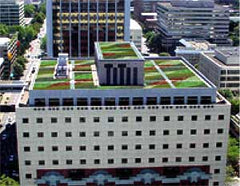 Green roofs, are building roofs that are partially or completely covered with vegetation and a growing medium, planted over a waterproofing membrane. Green roofs may also include layers such as root barriers/drainage systems. Green roofs serve many purposes such as adsorbing rainwater, providing insulation, creating a habitat for wildlife, and helping to lower urban air temperatures mitigating what is known as the heat island effect as well as:
- Reduction of stormwater run off
- Creating a natural habitat or "urban wilderness"
- Filter pollutants and CO2 from the air
- Contributing to LEED points
- Enhancing building aesthetics
- Increasing agricultural space, and
- In high densities, reduction of city's average temperature during the summer.
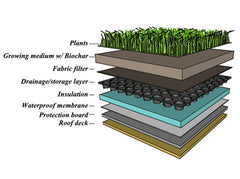 There are two types of green roofs for buildings; intensive roofs which are thicker and require more maintenance, and extensive ones which are lighter, have less vegetation and require less maintenance. Structurally, green roofs are comprised of: native vegetation, planting medium (soil-less), filter fabric, drainage/storage layer, insulation, waterproof membrane, protection board and roof deck.
Green roof growing media need to be designed to insure low concentrations of nutrients in stormwater run off. An important study run by Portland State University's Debbie Beck, concluded green roofs containing biochar showed significant increases in retention of nitrogen & phosphorus. The addition of biochar is a sustainable way to retain nutrients in the soil and improve water quality. Black Owl Biochar can also prevent Cu, Zn and Al that are often associated with run-off from green roofs and green walls.
 Biochar is rapidly replacing perlite as the medium-of-choice for green roofs, and Biochar Supreme's Environmental Ultra (TM) is an ideal soil-less component to green roof installations, particularly for its characteristics of high surface area, high activity, porosity and very light weight.
Given the need to keep the per/sq foot weight of the green roof installation low, our biochar is ideal due to the fact that it is a very light media, yet has a very great WHC, lessing water and irrigation needs.
A cubic yard of our Environmental Ultra weighs as little as 150 pounds per cubic yard, whereas many other biochars can get to be as heavy as 800-900 pounds per cubic yard. For a 1.25 quart sample of our Environmental Ultra or to order in bulk for your project, please click here.